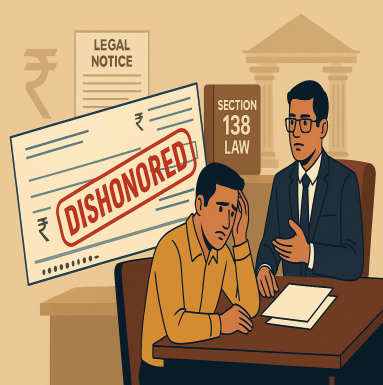
What is a Cheque Bounce Case and What Qualifies for Section 138?
In India, checks are one of the oldest and most widely accepted ways to pay for both personal and business transactions. Even though digital payments are becoming more common, people still use checks for big purchases, business deals, rent agreements, and other things. But sometimes the bank won't honour a cheque, which is known as a "cheque bounce." This is not just a financial problem; it can also be a serious crime under Indian law, especially Section 138 of the Negotiable Instruments Act, 1881.
In this article, we'll talk about what makes a cheque bounce case, when Section 138 action is appropriate, and what the legal process and consequences are. We'll also tell you about your rights and responsibilities and what to do if you are on either side of a dispute like this.
What is a case of a bounced cheque?
When a bank returns a cheque that was written by a drawer (the person writing the cheque) to a payee (the person receiving the cheque) without paying it, this is called a "cheque bounce case." There are many reasons why a cheque might not be honoured. The most common ones are that there isn't enough money in the account, the signatures don't match, the cheque has been written over, or the account is closed.
Reasons Why Cheques Bounce:
Not enough money: The account of the person who wrote the cheque doesn't have enough money to cover it.
Signature mismatch: The signature on the cheque doesn't match what the bank has on file.
Check presented before the date: The check is presented before the date on it.
Stale cheque: The cheque is given after the date it was issued (usually three months).
Account closed: The person who wrote the cheque has closed their bank account.
Other technical problems include numbers and words that don't match, a damaged cheque, overwriting, and so on.
What Does Section 138 Cover?
Section 138 of the Negotiable Instruments Act, 1881 specifically talks about the crime of dishonouring a cheque because there isn't enough money in the drawer's account or because the amount exceeds what was agreed to be paid.
For an offence to fall under Section 138, the following must be true:
In this article, we'll talk about what makes a cheque bounce case, when Section 138 action is appropriate, and what the legal process and consequences are. We'll also tell you about your rights and responsibilities and what to do if you are on either side of a dispute like this.
What is a case of a bounced cheque?
When a bank returns a cheque that was written by a drawer (the person writing the cheque) to a payee (the person receiving the cheque) without paying it, this is called a "cheque bounce case." There are many reasons why a cheque might not be honoured. The most common ones are that there isn't enough money in the account, the signatures don't match, the cheque has been written over, or the account is closed.
Reasons Why Cheques Bounce:
Not enough money: The account of the person who wrote the cheque doesn't have enough money to cover it.
Signature mismatch: The signature on the cheque doesn't match what the bank has on file.
Check presented before the date: The check is presented before the date on it.
Stale cheque: The cheque is given after the date it was issued (usually three months).
Account closed: The person who wrote the cheque has closed their bank account.
Other technical problems include numbers and words that don't match, a damaged cheque, overwriting, and so on.
What Does Section 138 Cover?
Section 138 of the Negotiable Instruments Act, 1881 specifically talks about the crime of dishonouring a cheque because there isn't enough money in the drawer's account or because the amount exceeds what was agreed to be paid.
For an offence to fall under Section 138, the following must be true:
1. A cheque was written for a debt or liability that can be legally enforced
The cheque must have been written to pay off a debt or obligation that could be enforced by law. Section 138 does not apply if the cheque is given as a gift, a donation, or for an illegal purpose.
The cheque must have been written to pay off a debt or obligation that could be enforced by law. Section 138 does not apply if the cheque is given as a gift, a donation, or for an illegal purpose.
2. The cheque was given within the time frame it was valid.
The person who receives the cheque must take it to the bank within the time it is valid, which is usually three months from the date it was written.
The person who receives the cheque must take it to the bank within the time it is valid, which is usually three months from the date it was written.
3. The cheque was sent back unpaid
The bank sends the cheque back unpaid because of:
Not enough money
Going beyond the deal
Any other reason listed in Section 138, but mostly because there isn't enough money
4. Notice of Demand Sent to Drawer
The payee must send a written legal notice to the drawer within 30 days of getting the return memo from the bank, asking for payment of the cheque amount.
The bank sends the cheque back unpaid because of:
Not enough money
Going beyond the deal
Any other reason listed in Section 138, but mostly because there isn't enough money
4. Notice of Demand Sent to Drawer
The payee must send a written legal notice to the drawer within 30 days of getting the return memo from the bank, asking for payment of the cheque amount.
5. The drawer doesn't pay within 15 days
If the drawer doesn't pay within 15 days of getting the notice, the payee can file a criminal complaint in court within the next 30 days.
Step-by-Step Legal Process Under Section 138
If the drawer doesn't pay within 15 days of getting the notice, the payee can file a criminal complaint in court within the next 30 days.
Step-by-Step Legal Process Under Section 138
1. Showing the Bill
The person who gets the cheque deposits it in their bank before it expires.
The person who gets the cheque deposits it in their bank before it expires.
2. Memo for Dishonoured and Returned Checks
If the cheque is not honoured, the bank sends a "Cheque Return Memo" to explain why.
If the cheque is not honoured, the bank sends a "Cheque Return Memo" to explain why.
3. Notice of Law
The payee sends the drawer a legal notice (demand notice) within 30 days of getting the return memo. The notice says that payment must be made within 15 days.
The payee sends the drawer a legal notice (demand notice) within 30 days of getting the return memo. The notice says that payment must be made within 15 days.
4. Time to Wait
The drawer has 15 days to cash the cheque.
The drawer has 15 days to cash the cheque.
5. Making a complaint
The payee can file a criminal complaint under Section 138 in the Magistrate court within 30 days of the notice period ending if the drawer doesn't pay.
The payee can file a criminal complaint under Section 138 in the Magistrate court within 30 days of the notice period ending if the drawer doesn't pay.
6. Court Cases
The case is going forward according to criminal law. If the drawer is found guilty, they may have to pay the fines that are set.
Punishments and Penalties In Section 138
Section 138 is not just a civil law; it is also a criminal law. The court may order the following if the accused is found guilty:
Prison time: up to two years, or
Fine: up to twice the amount of the cheque, or
Both: jail time and a fine
The court can also tell the drawer to pay the payee, and in some cases, make the offence worse if both sides agree to settle.
The case is going forward according to criminal law. If the drawer is found guilty, they may have to pay the fines that are set.
Punishments and Penalties In Section 138
Section 138 is not just a civil law; it is also a criminal law. The court may order the following if the accused is found guilty:
Prison time: up to two years, or
Fine: up to twice the amount of the cheque, or
Both: jail time and a fine
The court can also tell the drawer to pay the payee, and in some cases, make the offence worse if both sides agree to settle.
Common Defences in Section 138 Cases
The accused (drawer) can fight a case of a bounced cheque for a number of reasons, such as:
The cheque was not for a debt that could be legally enforced.
The person who was supposed to get the cheque gave it to the bank after it had expired.
The payee did not send the legal notice on time.
Someone forged the signature on the cheque.
The bill had a significant change.
Every case is different, and the defences depend on the facts and proof.
Recent Changes and Trends in the Courts
Indian courts have stressed the need to quickly resolve cases of bounced checks in order to keep people's faith in the banking system. The Supreme Court has given low-cost ways to speed up trials, like digital hearings and even online notice services.
The Negotiable Instruments (Amendment) Act, 2018 also added rules for temporary compensation for the complainant and quick trial procedures, which made the law stronger and more useful for people who have real claims.
Some useful advice for avoiding disputes over bounced checks
Make sure you have enough money in your account before writing a cheque.
Check dates and signatures again.
For extra safety, use account payee checks.
Write down all the checks you give and receive.
Respond quickly to legal notices or let them know if you can't make a payment.
What Legal Experts Do in Cheque Bounce Cases
If you are a complainant or an accused, it is very important to hire a lawyer who specialises in Section 138 cases or a cheque bounce lawyer. Lawyers can:
Make and send a good legal notice
Get ready to file the complaint in court.
Speak for you at hearings
If possible, try to reach a settlement or use another way to settle the dispute.
Their knowledge makes sure you don't miss important deadlines or make mistakes in the way you do things that could hurt your case.
In conclusion
In India, a bounced cheque case is a very serious matter that can have big financial and legal effects. Section 138 of the Negotiable Instruments Act gives a clear way to handle these kinds of problems, protect the rights of honest payers, and punish people who don't pay on purpose. If you are writing or receiving checks, it is important to know your rights and responsibilities and to get legal advice right away if you need it.
If you need legal help with a bounced cheque case, hiring a lawyer or advocate who specialises in this area will make sure that your rights are protected at every step of the way.
Do you still have questions about Section 138 or bounced checks? Call our legal experts at Legals 365 today for a private consultation!
Why Legals 365 and Advocate BK Singh Are the Best People to Help You with Cheque Bounce Cases
When you have to deal with the stress and complications of a cheque bounce case under Section 138, getting the right legal help can make all the difference in how your case turns out. Advocate BK Singh, who is very well-respected, runs Legals 365, which has become a top place for people in Noida, Delhi, Gurgaon, Ghaziabad, and beyond to get quick, dependable, and expert legal help with cheque bounce issues.
What Sets Legals 365 Apart?
Expertise in Cheque Bounce Cases: Legals 365 has a team that only works on cheque dishonour and Section 138 cases. They know the legal process, the paperwork, and how to plan ahead, so they can handle every step with professionalism, from sending the legal notice to representing you in court.
Client-Centric Approach: We treat each case as if it were the only one. Legals 365 gives you personalised legal advice that is specific to your situation, and they keep you informed and in control the whole time.
Speed and Efficiency: Cases of bounced checks need to be handled quickly. People know that Legals 365 acts quickly, whether it's writing and sending notices, filing complaints, or getting ready for court. Their streamlined processes make sure that deadlines are never missed.
Clear communication: Clients get regular updates and honest advice about the status of their case and what might happen next. This helps them trust us and feel at ease.
Pan-India Support: Legals 365 offers smooth legal services and local knowledge to help you with your cheque bounce case, no matter where you are in India, including Noida, Delhi, Gurgaon, Ghaziabad, and more.
Why Advocate BK Singh Is the Best Lawyer for Cheque Bounce
Years of Experience: Advocate BK Singh has worked on hundreds of cheque bounce and Section 138 cases, both for the complainants and the accused.
Proven Track Record: He is a leader in this field because he has a long history of winning cases, settling them quickly, and coming up with practical solutions.
Strategic and Assertive Representation: BK Singh is known for being strategic, writing legal notices that work, and being a strong advocate in court. He looks out for his clients' best interests at every step, whether he's negotiating outside of court or fighting in court.
Trust and Respect: People and businesses turn to him for help with cheque dishonour disputes because of his reputation for honesty, integrity, and hard work.
Full support at every step of the way
When you first contact Legals 365 and Advocate BK Singh, you get a full range of services:
A full analysis of the case
Putting together and sending Section 138 legal notices
Filing complaints and taking care of all the paperwork
Strong representation in court
Help with settlements or other ways to resolve disputes
Advice from experts on how to follow the law and make legal decisions
In conclusion
Don't leave your money and reputation to chance if you're in a dispute over a bounced cheque. Advocate BK Singh's unmatched knowledge guides Legals 365 in providing the best legal help for Section 138 and cheque bounce cases in India. You can be sure that you will get timely, effective, and results-oriented legal help with them by your side.
Call Legals 365 and Advocate BK Singh right away for a private consultation. This is the first step towards confidently solving your cheque bounce problem.
Common Questions (FAQs) about Legals 365 and Advocate BK Singh for Cases of Cheque Bounce
1. What help does Legals 365 offer for cases of bounced checks?
Legals 365 can help you with every step of your cheque bounce case, from analysing the case and writing legal notices to filing Section 138 complaints, representing you in court, and negotiating settlements.
2. Why should I hire Advocate BK Singh to help me with my bounced cheque case?
Advocate BK Singh is one of the best lawyers for bouncing checks. He has years of experience, a high success rate, and a reputation for being strategic and assertive when representing both the accused and the complainants.
3. Will Legals 365 be able to help me if I live outside of Delhi, Noida, Gurgaon, or Ghaziabad?
Yes, Legals 365 helps with bounced checks all over India and can help clients in different cities through both in-person and online consultations.
4. How soon after a bounced cheque can Legals 365 send a legal notice?
Legals 365 puts urgent cases first and can usually write and send a legal notice within 24 to 48 hours of getting the right documents and information from the client.
5. How much does it cost to hire Advocate BK Singh or Legals 365 for a case of a bounced cheque?
The fees depend on how complicated your case is and what stage it is at. Legals 365 makes sure that prices are clear and will give you a clear estimate after your first meeting.
6. Can Advocate BK Singh help settle disputes over bounced checks outside of court?
Yes, of course. Advocate BK Singh has a lot of experience with both litigation and negotiation. He has helped many clients get quick and good settlements without having to go to court for a long time.
7. How do I get started with my cheque bounce case with Legals 365 and Advocate BK Singh?
You can set up a meeting with Legals 365 by calling their helpline or going to their website. Advocate BK Singh and his team will help you figure out what to do next after they look over your case details and documents.
What is a Cheque Bounce Case and What Qualifies for Section 138?
1. What is a case of a bounced cheque?
A cheque bounce case happens when a bank refuses to honour a cheque because there isn't enough money in the account, the signature doesn't match, or there is some other technical problem. This is a crime under Section 138 of the Negotiable Instruments Act, 1881.
2. What does the Negotiable Instruments Act's Section 138 say?
In India, Section 138 makes it a crime to write a cheque that is not honoured because there isn't enough money in the account or the account arrangement is exceeded.
3. What needs to happen for a bounced cheque to be eligible under Section 138?
For Section 138 to apply, (a) the cheque must be for a legally enforceable debt, (b) the cheque must be presented within its validity period, (c) the payee must send a written legal notice within 30 days of dishonour, and (d) the drawer must not pay the amount within 15 days of receiving the notice.
4. What are the punishments for bouncing a cheque under Section 138?
The court can decide that the punishment is up to two years in prison, a fine of up to twice the amount of the cheque, or both.
5. Is it possible to settle a bounced cheque case without going to court?
Yes, many cases of bounced checks are settled peacefully outside of court if both sides agree, even after the legal process has begun.
6. Is there a deadline for filing a cheque bounce case under Section 138?
Yes. If the drawer doesn't pay within 15 days of getting a legal notice, the complainant has 30 days to file the case in court.
7. What paperwork do you need to file a case for a bounced cheque?
You will need the original bounced cheque, the bank's return memo, a copy of the legal notice sent to the drawer, proof that the notice was delivered, and any other communication about the cheque.
*****
"I was very stressed when my cheque bounced, but Legals 365 handled my case professionally and got it settled quickly." Advocate BK Singh made everything clear and kept me up to date at every step.
β€” Sanjay Verma
*****
"Thanks to Advocate BK Singh and the Legals 365 team, my case about a dishonoured cheque was handled quickly. They did all the paperwork for me and did a great job of representing me in court.
β€” Nusrat Jahan
*****
"Legals 365 is highly recommended for anyone who has problems with bounced checks." The legal advice was right on, and Advocate BK Singh's confident approach shows that he has a lot of experience.
β€” Rohit Malhotra
*****
"I like how quickly and clearly Legals 365 handles things." Advocate BK Singh is very smart and took great care of my Section 138 case.
β€” Jennifer Fernandes
"I was very stressed when my cheque bounced, but Legals 365 handled my case professionally and got it settled quickly." Advocate BK Singh made everything clear and kept me up to date at every step.
β€” Sanjay Verma
*****
"Thanks to Advocate BK Singh and the Legals 365 team, my case about a dishonoured cheque was handled quickly. They did all the paperwork for me and did a great job of representing me in court.
β€” Nusrat Jahan
*****
"Legals 365 is highly recommended for anyone who has problems with bounced checks." The legal advice was right on, and Advocate BK Singh's confident approach shows that he has a lot of experience.
β€” Rohit Malhotra
*****
"I like how quickly and clearly Legals 365 handles things." Advocate BK Singh is very smart and took great care of my Section 138 case.
β€” Jennifer Fernandes
*****
"I found Legals 365 on the internet, and I'm glad I did. Advocate BK Singh's knowledge helped me get my settlement quickly. The best for cases of bounced checks.
β€” Imran Mohammed
Do you need reliable legal advice? We give you clear, professional advice that is specific to your needs.
Are you having a legal problem? Let's work together to fix it with confidence.
Schedule Your Consultation

