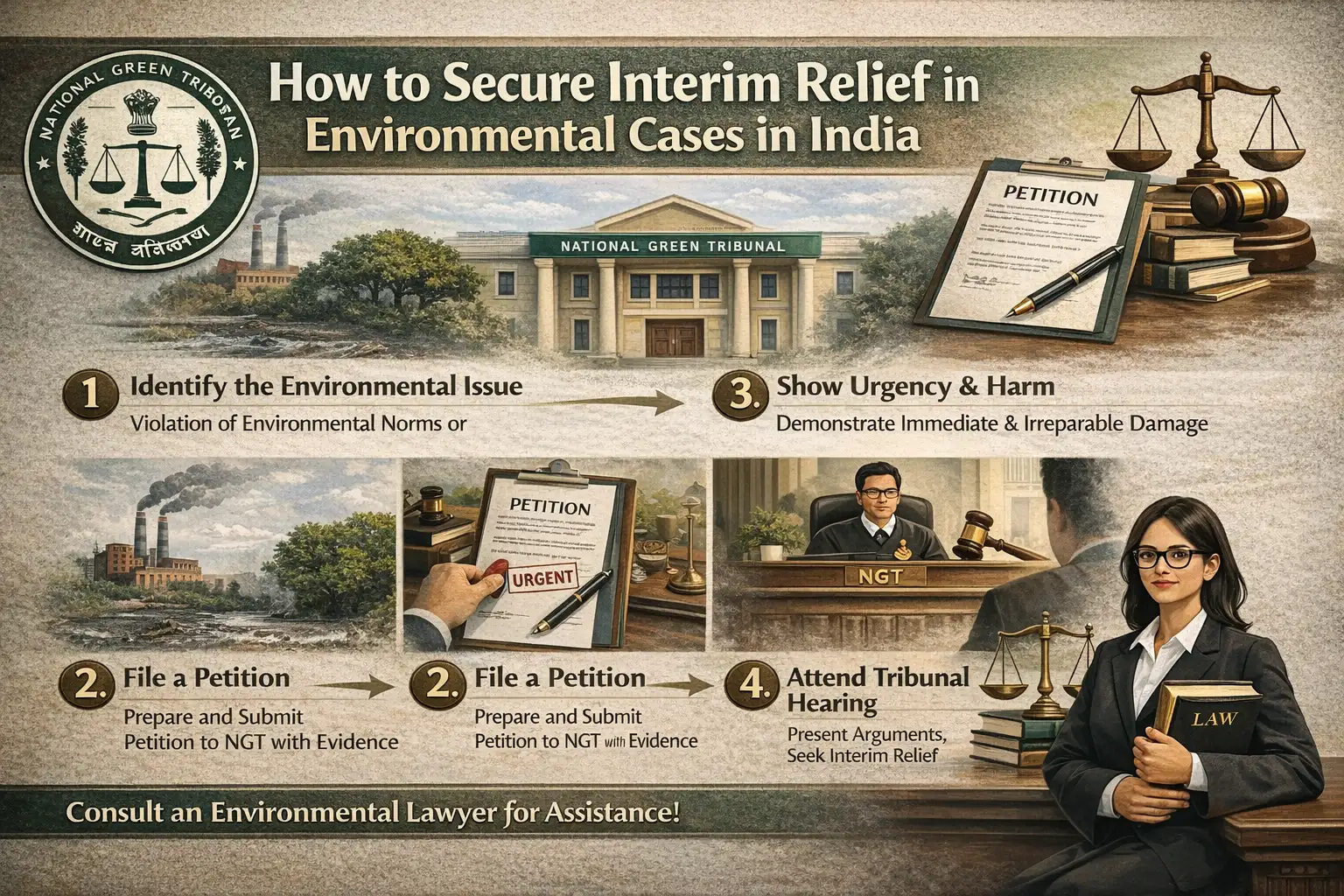
How to Get Temporary Help from NGT in India: A Practical Way to Get Projects Moving Again
When an environmental order suddenly stops construction, operations, questions approvals, or slaps environmental compensation, the damage starts right away. Contractor bills keep coming in, payroll gets tight, EMIs don't stop, and partners start asking hard questions. People in these situations usually want one thing first: immediate temporary protection.
This blog is for Indian families, RWAs, builders, clinics, schools, MSMEs, and small factories who want to learn about interim relief in environmental lawsuits in a way that isn't too complicated. You will learn what really affects interim protection, what kinds of evidence make it more urgent, and how Legals365 and Advocate BK Singh can help you make smart legal decisions.
Sometimes, the fastest legal protection also depends on picking the right mix of forums. In some cases, a well-timed High Court writ remedy may be useful. The goal is not to run everywhere, but to be smart when time is the biggest risk.
What Interim Protection Means in NGT Cases
An interim order is a temporary form of protection that is given while the main case is still going on. This is not the end of the battle. It is a break, a cushion, or a conditional permission that stops the case from falling apart right away until the tribunal hears it properly.
These are the most common forms of interim directions: Short-term protection at the start when there is a clear need for it Safe until the next date or until the next hearing Conditional protection, like a deposit, safeguards, compliance steps, limited operation, monitoring, or inspections, is one example.
The bench usually thinks about how important the case is, how fair it is, how bad it is for the environment, and how much hardship it will cause. If the situation can be handled with precautions, temporary relief becomes more likely.
Where People Most Often Need Temporary Help
In India, urgent requests for help usually come from a few things that happen over and over again:
Pollution control authorities taking action to close
A unit could be sealed or have to stop working. Salaries, supply commitments, and bank debts are all pushed to the limit.
Disruption of approvals and environmental clearance
There is a challenge, review, or limit on a project. Because uncertainty kills timelines, investors and banks act quickly.
Environmental compensation claims with a lot of pressure to pay quickly
The amount is high, the time frame is short, and for an MSME, the demand can become life-threatening.
In all of these cases, interim relief isn't about begging for emotional help. It's about showing that something is urgent and pairing relief with safety.
What Usually Makes a Difference for Temporary Relief
You don't need to use fancy words. You need to be clear, have clean facts, and act responsibly.
1. An urgent need that can be proven and is clear
When there are dates and consequences that are immediate, the tribunal responds better to urgency. A short, well-supported timeline is better than a long, emotional story.
2. A responsible attitude toward the environment
A lot of people make the mistake of only talking about business loss. In environmental lawsuits, it's easier to get help if you can show that you understand the problem and are willing to do something about it.
c) a plan for safety measures to lower risk during the interim period
3. Paperwork that makes people trust each other
Most urgent matters don't work out because papers are missing, scattered, or don't match up. The bench needs to be able to see the timeline right away.
c) a history of compliance, like consents, permissions, monitoring results, registers, and reports; and d) proof of site, like photos and materials linked to the location when needed.
e) records of approvals and operations
f) help with the financial impact, like payroll, contracts, bank schedules, invoices, or project milestones
g) a short note that explains the annexes and does not go against the record
4. Temporary help along with damage control
Offering practical protections instead of asking for blanket relief is often the quickest way to get legal protection.
d) testing done by labs that are approved
e) being ready for a joint inspection or monitoring direction
This method usually works even when there are accusations, because it shows that you are taking responsibility instead of denying everything just to deny it.
Where People Often Go Wrong and Lose Early Protection
At Legals365, we notice a pattern in urgent cases that get put off or thrown out at the interim stage:
Filing in a hurry with missing attachments and dates that don't make sense Using copied formats that don't match their facts Making claims that are too strong and leaving out important information that comes to light later Only talking about losing money and not about protecting the environment Giving the bench technical material that isn't easy to read or understand
Interim relief isn't just about the law. It's also about being believable. Once trust is broken, urgency no longer helps.
A unit stops working, and the owner has to deal with pressure from workers, missed payments from suppliers, and bank EMIs all at once. If the unit shows that it is taking immediate corrective actions, has a clear compliance plan, and a clear explanation of the timeline, interim protection may be possible with conditions.
Example B: Allegations of site nuisance stop a housing project
Dust, trash, noise, and complaints from people in the area all lead to stop orders. A practical interim request can be more powerful if it includes a site management plan, safety measures for workers, time limits, and proof that mitigation has already begun.
Example C: MSME faced with a large demand for compensation
A big amount of money is quickly demanded, and the time to pay is short. A reasonable temporary solution usually looks at the basis of the calculation, fairness in the process, proportionality, and clear improvements in compliance. Depending on the facts, relief can mean time, a new direction for recalculation, or conditional protection.
Example D: Approval problems that affect the project's funding
Lenders act quickly when approvals are called into question. Instead of an absolute blanket prayer, a strong interim presentation may rely on compliance history, mitigation measures, public interest balance, and a limited relief request.
Why Middle-Class Clients and MSMEs Like Structured Support
Environmental lawsuits can be too much for people to handle because they combine legal, technical, and public interest arguments. Most small businesses and middle-class clients need:
A clear list of what is important right now help put documents in a believable order of events calm and factual representation A plan that makes sense for the next dates, not just a fight for one day.
This is where Advocate BK Singh's method comes in handy. He focuses on building a strong case and a responsible interim relief strategy, not on loud arguments.
How Legals365 and Advocate BK Singh Help with Temporary Relief Issues
Legals365 works with Advocate BK Singh to help clients move quickly when they need urgent interim protection. Support usually includes:
finding the fastest legal way to get help based on facts writing a clear note of urgency and request for temporary relief putting together annexes so the bench can quickly check the timeline giving a fair plan that deals with both environmental safety and hardship at the same time advising when a parallel remedy, such as a writ option, might be useful in very rare cases. A lot of clients come to us after wasting time because their paperwork wasn't finished. Taking care of things professionally early on can often stop damage that doesn't need to happen.
Note on how to handle evidence and records
Some things have to do with CCTV footage, complaints made online, records of employees, call logs, or digital communication. It is important to handle personal or sensitive information in a legal and minimal way. Only the information that is needed should be used, privacy should be protected, and the record should stay safe across forums.
When people think about appeal or higher forum protection
When the effects are very bad or happen right away, people often look for solutions outside of the tribunal. When there is an urgent, permanent harm, questions about jurisdiction, or legal issues that need a different way to fix them, higher forum strategy comes into play. A legal review based on facts should be done before making the decision so that time isn't wasted.
Note on Compliance
There is no need to delete the account because it won't be made until the port is finished.
*****
Rajesh Mehta
"Work at my site suddenly stopped, and the pressure from buyers became too much to handle. Advocate BK Singh stayed calm and made a reasonable temporary request for the case. We got some time to breathe and a clear plan for how to follow the rules.
Neha Sharma
"I didn't get what was important in urgent interim relief." The Legals365 team helped put the papers in order, and the presentation was very clear. It made me feel less stressed right away.
Imran Khan
"My unit was going to be shut down, and our pay was at risk. Advocate BK Singh made things clear and gave useful advice. The structured approach kept my business safe at the right time.
S. Prabhakaran
"The demand for compensation was impossible to pay all at once. The writing was sharp but polite and based on facts. After getting good advice and planning, I felt better.
Ritu Malhotra
"Our case had reports and claims that were hard to understand. Legals365 put the facts and papers in a way that made sense. We finally got a fair chance to be heard.
Frequently Asked Questions
Q7. Is it possible to get temporary protection with conditions?
Yes, interim relief is often conditional. For example, it may require a deposit, limited operation, monitoring, corrective steps, or cooperation with an inspection.
There's no reason for concern. There is no difficult-to-understand legalese.
Someone who has helped many people with the same problems gives you clear, honest advice. We want to make the legal process easy to understand and use for everyone.
+91-9625961599 Chat on WhatsAppSchedule Your Consultation


