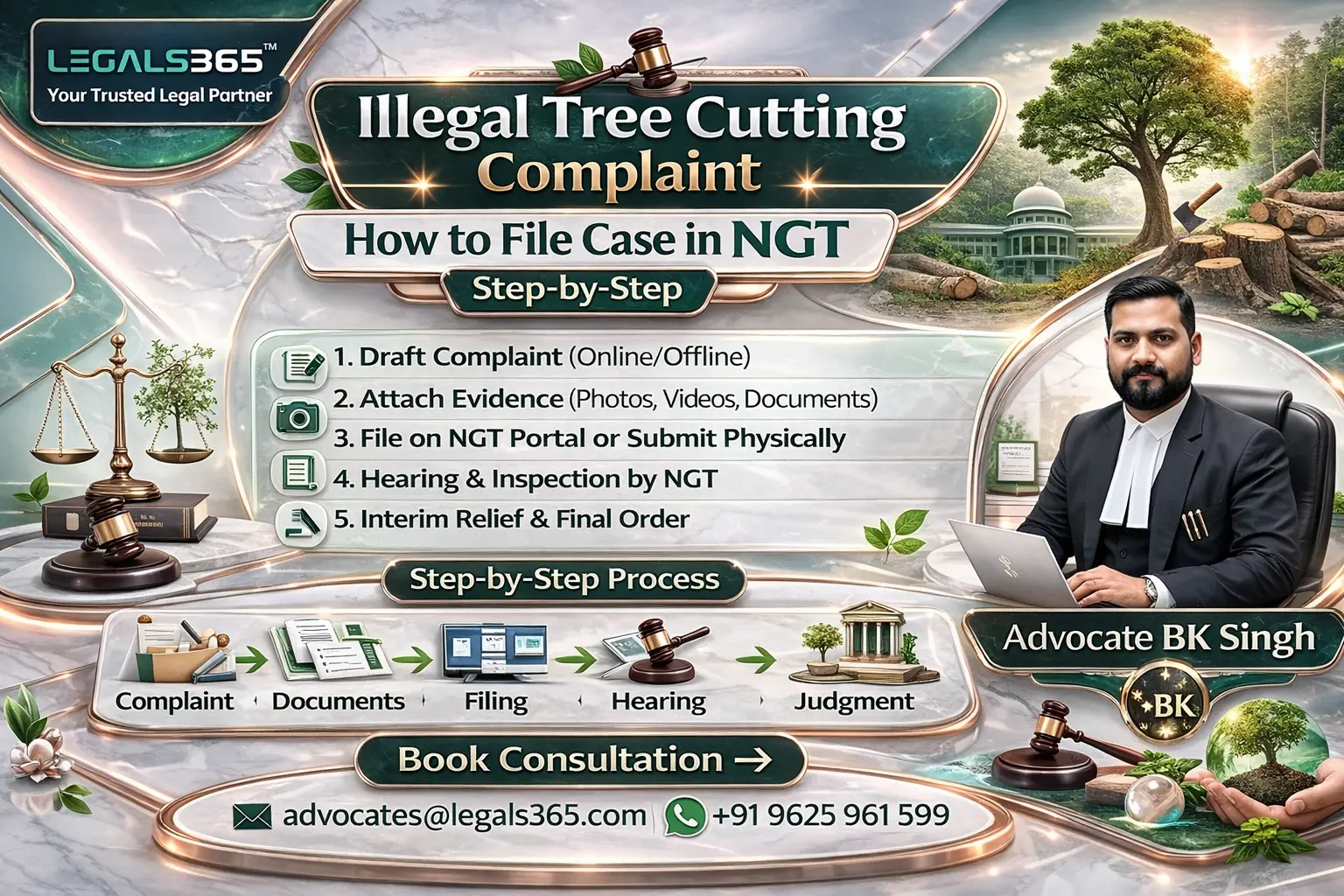
Illegal tree cutting complaint: how to file case in NGT step by step
Cutting down trees without permission is not only a problem in your neighborhood; it can also be a serious crime that puts people's safety, groundwater, heat levels, and the livability of the whole neighborhood at risk. People often feel powerless when trees disappear overnight, especially if they are cut down by a builder, contractor, society, or landowner who doesn't have permission. If you have the right evidence and the right place to present it, you can stop more damage and hold the violator accountable. This is often where a well-planned National Green Tribunal case is the best choice.
Legals365 helps regular people, RWAs, shop owners, and small businesses take action on time without getting lost in paperwork and confusion. Advocate BK Singh takes care of these things by putting the paperwork first. This way, your complaint won't be thrown out because of technical problems, and your urgent request for help will be clear. The Tribunal is more likely to issue orders for protection, site inspection, and restoration when the issue is framed as environmental harm with proof and clear requests.
1. When cutting down trees without permission becomes an NGT issue
Illegal tree cutting is an NGT issue when it causes a real environmental problem, not just a fight between two neighbors. Cutting in parks, green belts, ridge areas, forest-linked land, community land, or large-scale cutting related to a project usually counts because it changes the environment for everyone. If the cutting is happening quickly and the local government isn't doing anything, NGT is often the best place to get quick help and hold people accountable.
Legals365 gets the case ready in a way that the Tribunal wants, with facts first, proof first, and a clear focus on the environmental impact. Advocate BK Singh is trying to frame the issue as an irreversible harm to the public interest, not as a personal fight. This is good for middle-class families and small businesses because it cuts down on delays and makes it more likely that quick protective orders will be issued.
2. What permissions are usually needed, and how do people break them?
In most Indian cities, you need written permission from the right person, like the Tree Officer, the municipal body, the forest wing, or the development authority, to cut down trees or do major pruning. This depends on who owns the land. Permissions usually say how many trees there are, where they are, and what conditions apply, like transplanting, compensatory planting, and supervision. When a builder cuts down more trees than allowed, cuts down trees in a different area, cuts down trees at night, or uses an old approval for a new site, they are breaking the law.
Legals365 often sees people being shown only part of the papers or given verbal promises that permission is coming. This is not a legal defense when the trees are already gone. Advocate BK Singh tells his clients to think of the first two days as time to gather evidence, because once the stumps are gone and the debris is gone, the evidence gets weaker. The NGT case is based on a strong paper trail and pictures of the site.
3. A list of evidence that works in NGT
The best cases are clear and well-supported, showing what was there, what changed, who did it, and how it hurt. You should take wide-angle pictures of the area before and after, close-up pictures of stumps, cut trunks, and fresh saw marks, and short videos that show the work being done, the vehicles, the workers, and any site boards. If you can, take pictures of well-known places so that people can be sure of where they are. Also, keep the original files safe because screenshots often lose details.
Along with pictures, gather proof of complaints made to local authorities, such as receipts, diary numbers, and any written response or lack of action. Include information such as the date and time of the cutting, the number of trees that were cut down, and the names of the contractor or builder if you know them. Advocate BK Singh puts these annexes in a clear order so that the bench can understand the issue in a matter of minutes. This is exactly what helps with urgent interim relief.
4. A step-by-step guide to filing an NGT case for cutting down trees illegally
The first step is to write a complaint to the local government agency in charge of protecting trees in your area right away and keep a copy of it as proof that you acted quickly. Step two is to write a clear report of the incident that includes the date, time, place, number of trees, and people who are thought to be responsible, along with pictures and short videos. The next step is to write the NGT petition in a clear way, with the right party information, facts, grounds, and prayers that fit the harm, including urgent interim relief if cutting is still going on.
Step four is to file the case in the right NGT zone bench based on where you live and what state you're in. You also need to fill out all the paperwork, like an affidavit and annexures. Step five is to be ready for the first hearing with a short oral summary. This is because judges often ask what is going on right now and what kind of protection you want right now. Legals365 and Advocate BK Singh keep this presentation focused and useful, so your request doesn't get lost in emotional stories.
5. How to write the prayers for stopping work and restoring it
Your prayers should be clear and doable, not general or vague. To stop more cutting and trimming, ask for immediate directions to protect the site from tampering and to have the relevant authority inspect the site together. Ask the person who answered to give you the permissions, the records of tree marking, and the list of trees that were approved versus cut. This will show over-cutting and violations of conditions.
Instead of a one-time promise to plant trees, ask for a structured plantation plan that includes monitoring survival and regular reports. If the cutting is part of a project, ask the authorities to check the compliance conditions and punish anyone who breaks them. Advocate BK Singh frames these prayers in a way that makes sense, which is good for middle-class clients because it aims for relief that can be enforced, not just big statements.
6. Urgent interim relief: what courts look for in tree-cutting cases
When a court is looking for urgent relief, it usually looks for three things: ongoing harm, clear proof, and quick action on the complaint to show that it is urgent. If cutting is still going on, make it clear, send new pictures, and ask for immediate instructions to stop any more damage. If you're removing debris or uprooting stumps to hide evidence, say so because it shows how important it is to protect and inspect the site.
Legals365 sees interim relief as a request for safety and environmental protection, not as a personal attack. Advocate BK Singh also doesn't make big claims and instead focuses on facts that can be measured, like the number of trees, where they are, what the government isn't doing, and what work is still going on. Because the bench can trust the complaint file, this balanced approach often gets better results.
7. What results NGT can order and how compliance work?
The Tribunal can order inspections, ask for reports on actions taken, order restoration measures, and require compliance reports to be filed on certain dates. It can also tell the authorities to follow the rules that apply to trees and forests, and it can tell the people who want to build the project to follow the rules that protect the environment. Reports are used to check for compliance, and if they are wrong or missing information, you can file a response with new proof.
After the first order, Legals365 helps clients by keeping track of directions and writing clear responses to inspection reports. Advocate BK Singh often tells clients to keep documenting the site even after an order because violators sometimes start working again without anyone noticing. What turns an initial order into real protection on the ground is keeping records, following up politely, and giving clear answers.
8. Common mistakes that slow down the case and how to avoid them
People often make the mistake of filing late without saying why, which lets the other side challenge the limitation. Another mistake is not naming the right people, like leaving out the land-owning agency or the body that gives out permits. This leads to repeated notices and delays. People also send unclear photos or forward messages as proof, which makes them less credible.
To avoid this, file quickly, keep your evidence clean and original, and make a simple timeline that matches your annexures. Don't bring up personal issues in the petition; instead, stick to environmental damage. Also, don't make accusations you can't back up. Advocate BK Singh uses this strict method to keep clients from being fired and to keep the case moving in a way that leads to real relief.
Client Reviews
*****
Kavish Malhotra
Legals365 helped me when trees were being cut down near our colony late at night and no one was answering the phone. Advocate BK Singh calmly explained the process and asked for the exact evidence that was needed. I finally felt like the system could respond when the file was set up correctly. The advice helped me relax and gave our residents a clear plan.
*****
Ananya Menon
I was worried because the cutting was near a construction site, and I was afraid the builder would put pressure on me. Advocate BK Singh dealt with the situation in a mature way, focusing on the facts instead of the drama. Legals365 put the papers in order and made it easy for me to follow the steps. Throughout the whole process, I felt safe and supported.
*****
Rohit Choudhary
I own a small store, and the cutting started right next to our market lane, which caused problems with heat and dust. Legals365 helped me know how to file a complaint and keep evidence safe until everything was cleared. Advocate BK Singh gave useful advice and didn't waste time on things that weren't necessary. For me, the best part was how clear it was and how well it was followed up.
*****
Banerjee Prisha
Our society committee wasn't sure if we could even talk to NGT about this issue. Legals365 told us how to get there and helped us write a strong complaint with real proof. Advocate BK Singh made sure we stuck to the facts and talked about how the environment was hurt. It felt like a professional process that really helped regular people like us.
*****
Vikram Deshpande
I had pictures and videos, but I didn't know how to turn them into a real legal case. Advocate BK Singh told me exactly what to keep and how to make a clean timeline. Legals365 made sure that our complaint looked serious and believable by organizing the paperwork. It made me feel good that we were doing the right thing.
?FAQs
Q1. Can I file a case with the NGT for cutting down trees without permission?
Yes, if the cutting has a big impact on the environment, like cutting down trees on community land, green belt areas, forest-linked land, or large-scale cutting for a project. Good photos, a clear timeline, and proof of an authority complaint are all very helpful.
Q2. How long do you have to file a case in NGT for cutting down trees?
In general, you should file quickly after you notice the cause of action because waiting too long can cause problems with the law. Your case is safer if you act quickly and keep proof of when you first complained.
Q3. Do I have to tell the tree officer before I go to ngt?
It's usually a good idea to do it because it makes an official record and shows that you tried to fix the problem locally first. If the authority doesn't act and cutting keeps going, that record shows that NGT needs to act quickly.
Q4. What papers do I need to file a complaint about cutting down trees illegally?
Clear pictures, videos, complaint acknowledgments, location information, proof of identity, and any records of permission that are available. A neat annexure order makes things more believable.
Q5. Can ngt stop the cutting right away?
You can ask for urgent temporary orders to stop more cutting and call for an inspection. The bench usually needs proof that harm is still happening and that you are taking action right away.
Q6. Is it possible to file an NGT petition online?
Yes, a lot of people file through the e-filing process, but the petition still needs to be written correctly with an affidavit and attachments. Legal help can help you avoid being turned down for flaws.
Q7. Who should I make a party in a case about cutting down trees?
In most cases, the person or company doing the cutting, the agency that owns the land, and the people in charge of giving permission and keeping things safe. Choosing the right respondent keeps things moving.
Q8. What can I ask for in NGT if someone cuts down trees without permission?
Stop cutting any more trees, order an inspection, ask for permission to cut down trees, direct restoration and planting with monitoring of survival, and ask the authorities to take action against violators.
Q9. Is it possible to hold a builder responsible for cutting down trees without permission?
Yes, if illegal cutting is proven, the authorities can take action, and the Tribunal can order restoration and other actions. The case is based on evidence and the permission trail.
Q10. How much does it cost to file a case with the ngt?
The cost depends on how much paperwork needs to be done and whether you need a lawyer. A clean first filing can often lower the total cost by avoiding delays and having to make corrections over and over again.
There's no reason for concern. There is no difficult-to-understand legalese.
Someone who has helped many people with the same problems gives you clear, honest advice. We want to make the legal process easy to understand and use for everyone.
+91-9625961599 Chat on WhatsAppSchedule Your Consultation


