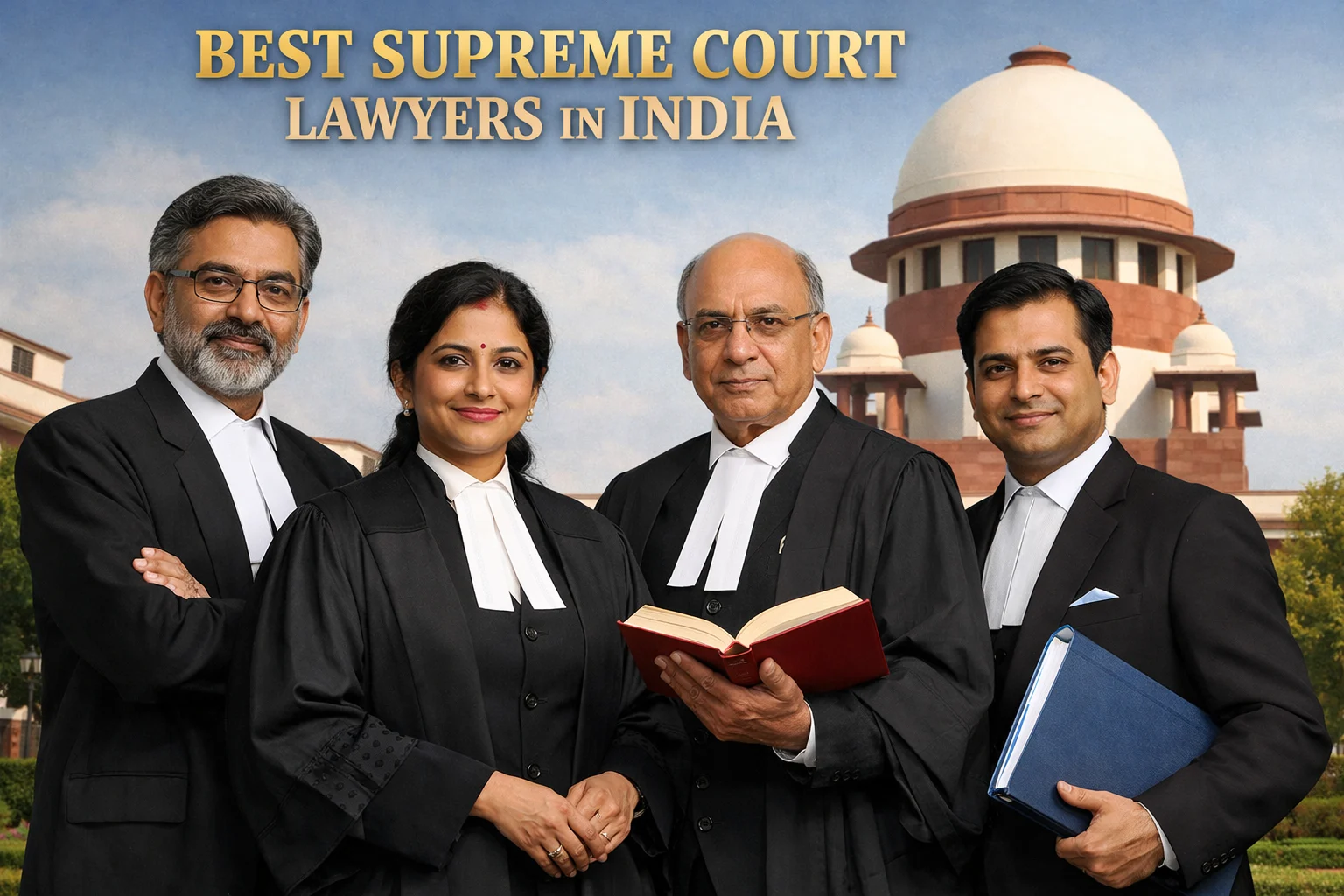
Best Supreme Court lawyers in India | Legals365 & Advocate BK Singh
"Best Supreme Court lawyers in India" is not just a phrase that people look up. It usually comes from not being able to sleep, having long arguments, and feeling like all other options are closing. A property case has been going on for years, a bounced check or loan recovery has turned into a criminal pressure tactic, a business is stuck in arbitration and blacklisting, or a family is facing a serious criminal case that could hurt their reputation and freedom. People don't usually feel calm when they think about going to the Supreme Court of India. They are tired, scared, and looking for someone who knows the law and can help them understand it.
In this case, it's important to know what the Supreme Court does, how cases get there, what "best Supreme Court lawyer in India" really means beyond big names, and how companies like Legals365, led by Advocate BK Singh, help middle-class people and small businesses who can't afford to waste time and money on endless experiments.
How to Understand Supreme Court Cases in India
The Supreme Court doesn't start most disputes in India. They start in trial courts, tribunals, or authorities and then go up to High Courts. Most of the time, the Supreme Court gets involved when someone is appealing a High Court decision or a tribunal order or when there is a big question about constitutional law or basic rights. When people have to deal with Special Leave Petitions (SLPs) against High Court decisions, transfer petitions between states, writ petitions about fundamental rights, complicated loan and recovery disputes, big property or builder fraud cases, serious criminal appeals and bail issues, or high-value commercial and corporate disputes that cross state lines, they often look for the "best Supreme Court lawyers in India."
For a middle-class person or a small business owner, the Supreme Court is not just "one more court." It is often the last chance to fix a legal problem that really matters. That's why the choice of lawyer, the clarity of the legal grounds, and the quality of the drafting are much more important than slogans, ads, or glamour.
In Real Life, What "Best Supreme Court Lawyer" Means
Many people think that the best Supreme Court lawyer is the one who is most often seen in the news or on TV debates. For a salaried worker, a small business owner, a startup founder, or an MSME entrepreneur, the word "best" means something very different. The best Supreme Court lawyer for these kinds of clients is someone who can give them a brutally honest evaluation, write a clear petition, stick to deadlines, and talk to them clearly.
A good Supreme Court lawyer will first tell you if your case is even eligible for the Supreme Court. They will let you know if there is a real legal or constitutional issue or if you are just unhappy with the lower court's decision. They will also stress that the Supreme Court is not there to go over every little fact again. Your lawyer needs to be able to read the whole case history, find legal mistakes, and turn them into short reasons that can be used in an SLP or writ petition in order to be truly helpful.
The next important trait is writing. At the admission stage, a lot of cases are thrown out because the SLP or petition is unclear, repetitive, or poorly organized. The best Supreme Court lawyers spend time writing down clear, chronological facts, specific legal mistakes, and focused legal questions. They don't think of drafting as a formality; they think of it as the case's base.
A good Supreme Court lawyer also knows how important time is and how to meet deadlines. Time limits are short. There are strict deadlines for certified copies, filing, fixing mistakes, and fixing mistakes. Clients may have to deal with bank auctions, criminal investigations, being put on a blacklist, or carrying out a court order. Every week is important to them. A good lawyer or a well-organized team knows how to handle documents, filings, and listings in a disciplined way.
Lastly, a good Supreme Court lawyer is someone who is easy to reach and realistic. It doesn't make sense for a middle-class person in Ghaziabad or a business owner in Noida or Bengaluru to hire a lawyer who is only available on hearing days. They need a company that answers the phone and emails, makes orders clear, and shares drafts before filing. This is where a team-based structure like Legals365, led by Advocate BK Singh, comes in handy: you get real legal work and communication at the same time.
How Legals365 Helps Real Clients with Supreme Court Cases
Legals365 helps a group of clients that traditional Supreme Court practice doesn't always help. These are people who work for a salary and are facing aggressive loan recovery, families who are tired of long-running criminal or property disputes, small business owners who are trying to stay afloat after being blacklisted or having their contracts arbitrarily changed, and MSMEs who are dealing with DRT, SARFAESI, or large recovery claims. Advocate BK Singh leads the firm, which uses a structured and documentation-led approach instead of one based only on personality.
Most of the time, the process begins with a thorough case audit and a written or clear oral opinion. Legals365 says that before telling a client to file an SLP or writ in the Supreme Court, they must look over all the important documents. These include trial court orders, High Court judgments, tribunal orders, FIRs and charge sheets in criminal cases, loan documents and recovery notices in bank disputes, and contracts and correspondence in business cases. The team then decides if there is a real legal issue that the Supreme Court should look into or if other options like review, modification, settlement, or alternate forums would be better. A lot of clients feel better when they hear an honest "no" instead of a false promise because they know that someone has finally looked at the whole file carefully.
The next big step is drafting if a Supreme Court filing is appropriate. Legals365 makes SLPs, writ petitions, and transfer petitions with clear questions of law, tight chronological facts, and short but sharp legal grounds. The firm doesn't fill pages with emotional stories; instead, it focuses on what will matter to a Supreme Court Bench: Where is the legal error? What did the violation of natural justice look like? What laws or past decisions were ignored? What is the bigger legal idea at play? Clients get copies of drafts so they can fix any mistakes and feel like they are part of the process.
In many cases, what is needed right now is not a final decision but temporary protection. A borrower might need a stay on auction or repossession, a director might need protection from arrest or coercive steps, and a small business might need an order that stops blacklisting from being acted upon until the case is heard. Legals365 keeps this in mind when writing petitions, making sure that requests for temporary relief are worded correctly, backed up by the right documents, and sent at the right time.
What happens in the lower courts is also very important for Supreme Court advocacy. Legals365 works with local lawyers in trial courts, High Courts, DRT, NCLT, and other courts to make sure the record is complete, certified copies are available, and there are no gaps in the story that aren't explained. Instead of a pile of messy papers, the Supreme Court Bench should get a clear, organized picture. This level of care is especially important when clients are middle-class families or small businesses that can't afford to fix mistakes or file again and again.
Indian Point of View on Real-World Style Scenarios
Think about what it's like for a salaried borrower from Ghaziabad. He has a mortgage, a top-up loan, and a personal loan. He defaults after losing his job and having to pay for hospital bills. The bank starts SARFAESI proceedings, but the DRT won't protect him. He feels like he's been through hell and is now looking online for the best Supreme Court lawyers in India to help him with his loan and recovery cases. When he talks to Legals365, Advocate BK Singh's team doesn't just say, "We'll go to the Supreme Court, and everything will be fine." Instead, they look at the notices, the value of the property, the bank's behavior, and the previous orders. They tell him if there is a real Supreme Court challenge and help him look into a structured one-time settlement at the same time. The goal is clear: keep the house safe, avoid a panic auction, and settle the dispute in a smart way.
Here's another example: a small IT services company in Bengaluru. A government department suddenly puts the company on a blacklist after a contract dispute. The High Court throws out their writ petition, and the founder thinks her whole business is over. When she calls Legals365, the team looks over the blacklisting order, previous letters, and the High Court's decision. Instead of treating it like a normal problem, they change the way they think about it to be about unfairness and a violation of natural justice under Article 14. They point out that sudden blacklisting can ruin MSMEs without a real hearing. The SLP filed in the Supreme Court focuses on this constitutional aspect and asks for temporary relief so the company can take part in tenders. The method mixes knowledge of constitutional law with knowledge of how things really are.
In a third case, a businesswoman from Delhi is facing several cases of bounced checks under Section 138 of the Negotiable Instruments Act, as well as a criminal case that is related to them. She is scared of being dragged into parallel proceedings again after the High Court ruled against one of her petitions. Legals365 does not recommend filing separate, scattered petitions out of desperation. The team looks at how the cases are similar, what the transactions are like, and what the previous orders said. Then, they come up with a plan for the Supreme Court. This could mean an SLP with limited but strong grounds, along with active talks about settling the case and restructuring the debts. For her, the value isn't just having a Supreme Court case number; it's also working toward settling all of her disputes while protecting her business and reputation.
Why Small Businesses and Middle-Class Families Like a Structured Team
A lot of people are scared to go to the Supreme Court. They think about huge, unpredictable fees, lawyers who don't have time to talk, complicated case numbers, and never-ending delays. Companies like Legals365, led by Advocate BK Singh, are trying to change this on purpose. Instead of hiding fees behind vague estimates, they are clear about their fee slabs and stages. Before any filing, clients get clear written or spoken opinions so they aren't surprised later. Before being filed, drafts are shared to make sure the facts are correct. We explain orders in simple English or Hindi, depending on which language the client is more comfortable with.
This way of working gives both legal and emotional peace of mind to middle-class families in Lucknow and small businesses in Kochi. They know that a team is taking care of deadlines and paperwork, and they know that their opinions are heard during strategy meetings. When people type "best Supreme Court lawyers in India" into Google, they are looking for that mix of legal structure and human sensitivity.
How to Pick the Best Supreme Court Lawyer for Your Case
When you're picking a lawyer or law firm to work on a possible Supreme Court case, it's helpful to think in practical terms. Think about whether the lawyer has worked on cases like yours before. For example, is it a loan recovery case, a SARFAESI challenge, a check bounce matter, a property dispute, a government contract dispute, a blacklisting, or a serious criminal appeal? Having experience with your type of case is much more important than being famous.
You should also demand an honest evaluation right away. A good lawyer won't promise that the Supreme Court will definitely reverse every order or guarantee success. Instead, they will talk about the good and bad points of your case, any problems with the law, and other options like review or modification in the High Court, settlement options, or partial challenges.
Another important thing is to be clear about who will write, argue, and coordinate filings. In some cases, juniors are in charge of drafting with little oversight, and clients never see the petition before it is filed. Advocate BK Singh keeps a close eye on drafting and strategy for a team like Legals365, and the client is always kept up to date. You should also pay attention to how they talk to you. Do they use simple language, answer messages, and send you regular updates, or do they disappear between dates?
Lastly, a good Supreme Court lawyer should know the law well but be open to different ways to solve problems. That means they should be ready to fight hard when they need to, but they should also be open to mediation, settlement, restructuring, or other solutions, especially when your home, business, or long-term reputation is on the line.
Client Reviews
*****
Rajesh Verma from Ghaziabad
Rajesh says that when his housing loan turned into a nightmare and the bank sent him an auction notice, he felt completely broken. A friend told him how to get in touch with Legals365 and Advocate BK Singh. Someone sat down with his papers for the first time and explained the Supreme Court option in plain language. They also gave him a realistic idea of the costs, time, and risks involved. The team filed the case on time, which gave him some breathing room from the threat of auction and helped him negotiate with the bank at the same time. He still lives in his flat today, and he thanks Legals365 for helping him with that.
*****
Meenakshi Iyer lives in Bengaluru.
Meenakshi owns a small IT services business, but she was suddenly blacklisted after a disagreement over a contract. She thought her business was over when the High Court ruled against her. Legals365 looked over every document by email and video call. Meenakshi remembers how Advocate BK Singh's team made a well-thought-out SLP that focused on fairness, natural justice, and how it would affect a small business, rather than just emotional arguments. She felt supported at every stage because drafts and updates were sent to her on a regular basis, and she was treated like a partner in the case instead of just a file.
*****
Imran Khan Lucknow
Imran talks about how his family was stuck in a long criminal case because of false accusations. He almost lost hope when the High Court refused to stop the case. He went to Legals365 because a coworker told him to. He was most impressed by how honest the first meeting was. The team didn't promise miracles. Instead, they looked over the FIR, charge sheet, and orders, explained which legal arguments could be made before the Supreme Court, and made it clear what couldn't be undone. His family was finally able to sleep at night after the petition was filed and he was given protection from arrest.
*****
Pooja Sharma is from New Delhi.
Pooja, who owns a small business in Delhi, was dealing with a lot of bounced checks and a criminal complaint that went along with them. She was tired from going back and forth between different courts and dates. Advocate BK Singh and his team looked at all of her cases when she called Legals365 and came up with a plan that worked for all of them. They suggested a unified legal plan that could include a Supreme Court challenge on key issues along with ongoing talks to settle the case, rather than looking at each case separately. Pooja says that this way of doing things made her feel like someone was finally looking at her whole life, including her money, mental health, and business continuity, instead of just one file.
*****
Suresh Nair from Kochi
Suresh was in a complicated property dispute that involved two states and an old High Court decision. He found Legals365 while looking online for the best Supreme Court lawyers in India. He remembers that the team didn't rush to file. They patiently gathered the missing papers, asked his local lawyer for more information, and then told him to file a carefully limited challenge instead of going after everything at once. This saved time and money and made it less likely that the petition would be seen as unfocused. Suresh felt better knowing that the work was being done in a calm, methodical way and that everyone was clear about the costs and chances.
?FAQs
Q1. How can I tell if my case is good enough for the Supreme Court of India?
When there is a serious legal or constitutional question that goes beyond normal facts, like a clear violation of basic rights, a big question of law, conflicting decisions by different High Courts, or a major procedural injustice, you can usually tell that the case may be right for the Supreme Court. But you shouldn't make this choice on your own. The best way to find out if a Supreme Court filing makes sense for your case is to have an experienced Supreme Court lawyer or a specialized team like Legals365 go over your whole file. They can read the previous orders, find possible legal grounds, and then tell you the truth.
Q2. What does the Supreme Court mean by an SLP (Special Leave Petition)?
A Special Leave Petition is a way for someone to ask the Supreme Court for permission to appeal a lower court or tribunal's decision, usually a High Court's. This is allowed by Article 136 of the Constitution. The Supreme Court has the power to decide whether to grant leave or not, even if you think the order is unfair. This is why it is very important to write and organize an SLP: the facts must be short and clear, the mistakes in the order being challenged must be pointed out, and the legal questions must be framed in a way that shows why the case needs the Supreme Court's attention.
Q3. When do I have to file an SLP in the Supreme Court?
For most civil and criminal cases, an SLP must be filed within a certain amount of time, usually about 90 days from the date of the High Court or tribunal judgment. Some types of cases have shorter deadlines. There are laws that allow for delays, but the Court does not automatically accept late filings. So, as soon as you get an unfavorable order, you should talk to a Supreme Court lawyer or a company like Legals365 so that certified copies can be made, documents can be put together, and the petition can be written and filed before the deadline.
Q4. Is it realistic for people in the middle class to be able to afford a Supreme Court case?
Yes, people in the middle class can go to the Supreme Court, but they need to plan ahead and be clear about how much it will cost. Court fees, drafting fees, filing fees, and lawyers' professional fees are all costs that come up in Supreme Court cases. Legals365 is a client-friendly team that helps by breaking these down into clear steps, explaining when each charge will be due, and focusing on a well-prepared, targeted petition instead of filing too many unnecessary papers. Many salaried people and small business owners find that Supreme Court cases are manageable when they set clear goals and focus on the strategy. This is especially true when the stakes are high, like losing a home, freedom, or a job.
Q5. Can I go straight to the Supreme Court without going through the High Court first?
You should try all of your options in lower courts and the High Court before going to the Supreme Court. But there are times when a person can go directly to the Supreme Court under Article 32 of the Constitution, such as when a basic right is violated or when something has immediate national or pan-India effects. It depends on the case, the options for getting help, and how urgent it is whether a direct writ in the Supreme Court is a good idea. An experienced lawyer like Advocate BK Singh would usually look at your case and then tell you if you should go to the High Court or another forum first, or if you should go directly to the court.
Q6. Do I have to go to Delhi for my Supreme Court case?
Clients come from all over India to see the Supreme Court, which is based in New Delhi. In a lot of cases, only the lawyers are in court, and the clients stay in their home cities and coordinate things. Companies like Legals365 handle communication by phone, email, WhatsApp, and video meetings, and they send drafts and orders digitally. If you need to be there, you might have to go to Delhi for some important conferences or hearings. However, a lot of the planning, briefing, and updating can be done from afar, which makes it easier for clients in other states to handle their Supreme Court cases.
Q7. What papers do you need to file a case with the Supreme Court?
The exact list will depend on your case, but you will usually need the judgment or order you want to challenge, previous orders from lower courts or tribunals, relevant pleadings like petitions, replies, and rejoinders, and supporting evidence like agreements, financial records, notices, emails, FIRs, charge sheets, or any other documents that show what really happened. Legals365 is a team that can help you put these papers together in a neat, indexed way that follows Supreme Court rules. This will make the filing go smoothly and make it easy for the judges to follow your story.
8. Can the Supreme Court stop the sale of a bank or the recovery process?
The Supreme Court can give temporary relief, such as stopping bank auctions or changing coercive recovery steps, but only if the case needs that kind of protection. The Court will look at how the borrower acted, what the transaction was, whether the bank's actions were legal, and whether there is a big legal issue. Advocate BK Singh and the Legals365 team often deal with these kinds of issues by combining legal action with real-world negotiation. This way, the client can ask the Court to protect their home or business assets while also working on a realistic settlement or restructuring plan.
9. How do lawyers in India usually charge for Supreme Court cases?
In India, there is no set amount for Supreme Court fees. They change depending on the number of hearings, the seniority of the lawyer, the complexity of the case, and how quickly it needs to be resolved. A lot of people think that only famous people can handle a case well, but that's not always true for disputes between middle-class people or small businesses. Legals365 is a structured team that usually gives clear steps for drafting, filing, and arguing. They may also break up payments into stages, which helps clients plan their budgets. The most important thing is to be clear and honest from the start so there are no bad surprises later.
Q10. Why should I hire Legals365 and Advocate BK Singh for my case in the Supreme Court?
If you're a middle-class person or a small business owner who needs both strong legal help and practical advice, you might want to look into Legals365 and Advocate BK Singh. The team focuses on honestly evaluating cases, carefully writing SLPs, writs, and transfer petitions, and coming up with a strategy that focuses on getting people out of trouble in cases like loan recovery, SARFAESI action, check bounce cases, property disputes, criminal proceedings, and business conflicts. People often look for the best Supreme Court lawyers in India without even knowing it, and this is what they find: lawyers who know a lot about the Supreme Court and can understand how hard it is for regular families and MSMEs to deal with money and stress.
There's no reason for concern. There is no difficult-to-understand legalese.
Someone who has helped many people with the same problems gives you clear, honest advice. We want to make the legal process easy to understand and use for everyone.
+91-9625961599 Chat on WhatsAppSchedule Your Consultation


