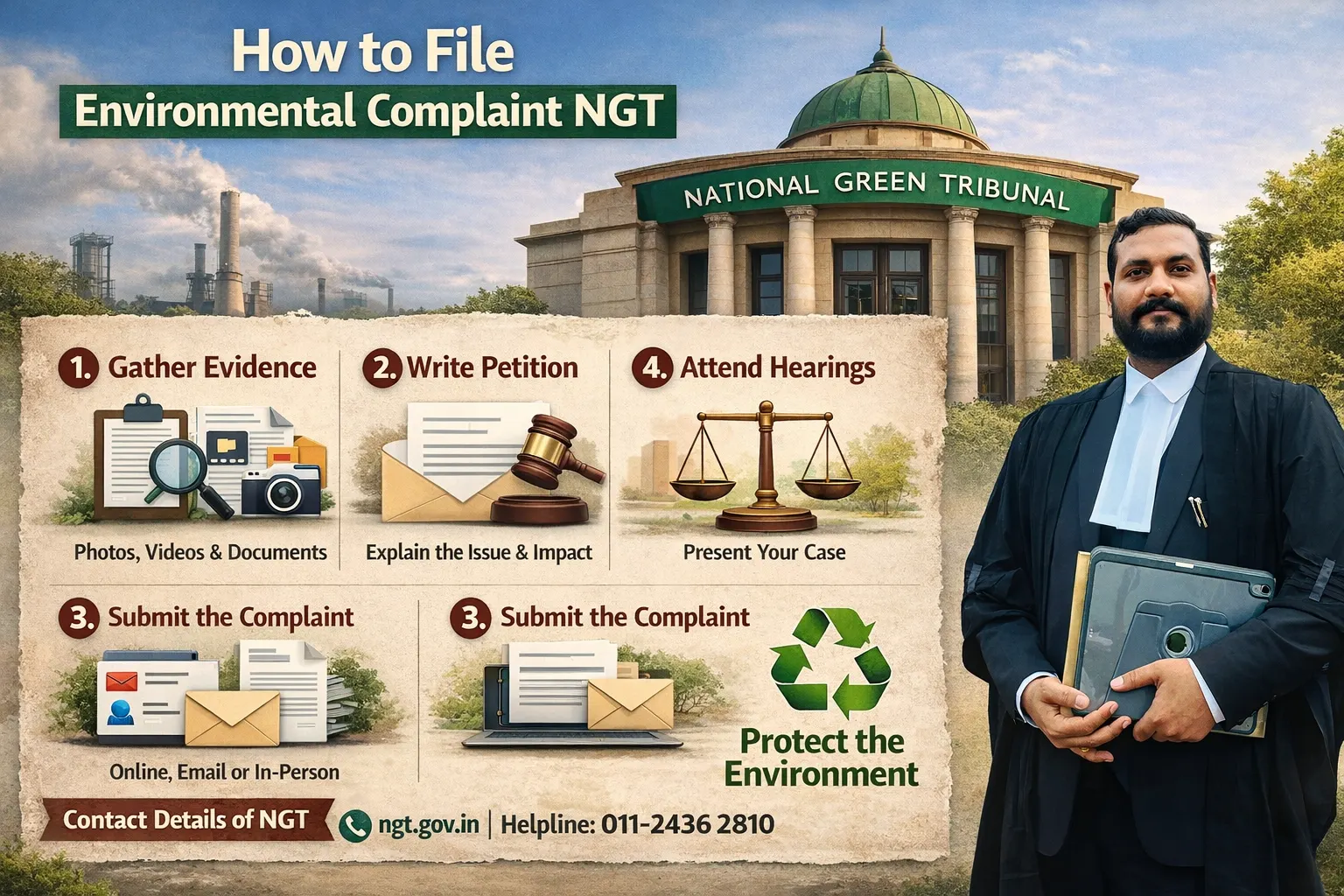
How to Make a Complaint About the Environment NGT
When pollution starts to have an effect on everyday life, people usually go to the local office first. They write to the RWA, the builder, the pollution control board, or the city government. That works sometimes. But if untreated sewage keeps flowing, a STP doesn't work, the smell spreads through the neighborhood, groundwater gets contaminated, or complaints keep being ignored, the issue can go beyond normal administration. That is the point at which it makes sense to file an environmental complaint with the National Green Tribunal.
The National Green Tribunal, or NGT, is a special place for settling environmental problems, paying damages, and restoring the environment. It handles civil cases that have big environmental issues under the laws listed in Schedule I of the NGT Act. The official NGT system has e-filing, a Principal Bench in Delhi, and zonal benches. The Tribunal is supposed to handle environmental cases quickly.
For a lot of middle-class families and small businesses, damage to the environment is not just an idea. It is very private. It means sewage backing up near stores, a residential society living next to untreated discharge, tenants refusing to stay, children getting sick from bad air, or property values going down because a project's sewage treatment system isn't working. In these kinds of situations, a well-written NGT complaint can make the authorities, polluters, project operators, builders, or city agencies respond in court.
Legals365 takes a practical approach to things like this. Advocate BK Singh's first job is to figure out what the real problem is, who the right respondents are, and what the right evidence is. Then he or she decides whether the case should go to the NGT, a pollution control authority, or another forum. That clarity is important because a lot of people waste time by filing the wrong complaint in the wrong place.
When is the best time to file an environmental complaint with NGT?
When there is ongoing environmental damage and official complaints haven't worked, you should seriously think about filing before the NGT. Some common examples are letting untreated sewage flow into the environment, not following STP rules in residential or commercial projects, polluting groundwater, dumping trash illegally, polluting the air and water, cutting down trees, polluting lakes or drains, dealing with hazardous waste, and other issues that affect public health and the environment.
These are not just words you can search for. They show real problems in Indian housing societies, mixed-use developments, townships, industrial areas, and peri-urban colonies where broken sewage systems put people's health and the environment at risk.
What kinds of STP issues can go to NGT?
A lot of people only call lawyers after months of dealing with builders, facility managers, or local governments. In real life, STP-related arguments often happen in these kinds of situations:
An STP is in a group housing society, but the water quality is bad and it smells bad every day.
Someone is dumping raw sewage into a stormwater drain, a nearby empty lot, a pond, or a natural body of water.
A builder promised a working sewage treatment system, but the plant never worked right.
A business or institution is running without enough sewage treatment, and people who live nearby are having problems.
People have complained to the city government, the pollution control board, or the maintenance agency, but the problem keeps happening.
Recent reports also show that NGT and other relevant authorities are still dealing with complaints about STPs and are sending inspectors to check for compliance and take action when sewage treatment failures affect residents.
Is every pollution problem good for NGT?
No. That's why it's important to do legal screening.
The NGT handles civil disputes about the environment and relief under the NGT Act. Section 14 of the Act deals with disputes that involve a major environmental issue, Section 15 deals with relief, compensation, and restitution, and Section 16 deals with appeals against certain environmental orders.
This is where Legals365 and Advocate BK Singh help clients avoid making costly mistakes. A complaint that is emotionally strong but not clear about the law often fails. A complaint that is written down, organized, and linked to the right environmental violation is much stronger.
1. Find the exact environmental wrong
Don't start with anger. Start with accuracy.
For instance, in a STP case, the problem could be untreated sewage discharge, a bad smell that keeps coming back, overflow into drains, bad maintenance, illegal bypassing of treatment, or running the system without following the rules.
2. Get proof before you file
This is where strong cases are made.
Some useful evidence is:
pictures and videos with dates copies of complaints sent to the builder, RWA, municipal body, DPCC or SPCB, CPCB, Jal Board, or local authority any inspection reports water test reports or lab reports, if they are available medical records if someone says their health is bad
maps of the site, brochures about the project, records of maintenance, and permissions news articles or public notices, if they are important
complaints and representations from residents that were signed
A surprising number of people say, "Everyone knows about the problem." That's not enough in court. The NGT needs a strong factual basis.
3. 3. Pick the right people to answer
This step determines if the case proceeds correctly.
When it comes to environmental issues, the wrongdoer isn't always the only one who has to answer. Depending on the facts, the parties may be:
builder or developer RWA or a maintenance company city government DPCC or the state pollution control board authority for development
jal board or the authority in charge of sewage a business, a plant operator, a contractor, or a group of institutions
Advocate BK Singh usually starts with responsibility and enforcement power. That helps figure out who needs to be held accountable.
4. Know about the limitation issue early on
A lot of people don't pay attention to this part.
Under the NGT Act, most applications under Section 14 must be filed within six months of the event that started the case. There is a small extension available if there is a good reason. Under Section 15, claims for compensation or restitution have a wider range of time limits, and appeals under Section 16 have their own shorter time limits.
Simply put, don't wait too long to deal with it.
In cases of ongoing environmental harm, the legal strategy may involve proving that the pollution is happening again and again, but this needs careful writing. This is one reason why people go to Legals365 before the time limit runs out.
5. Write the petition correctly
A good NGT petition isn't a rant. It is a legal document with a structure.
It usually has:
information about the applicant information about the people who answered Statement of Jurisdiction facts in the order they happened complaints that have already been made involved in breaking the law about the environment damage done to people, land, water, air, or the environment temporary help sought final help needed list of documents and attachments In STP lawsuits, the writing must make it clear whether the complaint is about not following the rules, dumping untreated sewage, causing environmental problems, not doing what the law says, or putting public health and the environment at risk.
6. Get ready the annexes and document set
The NGT's own filing framework and information booklet say that the application or appeal must be filed in the right way with the right documents. The e-filing system lets people upload petitions and documents through the applicant portal.
That means your annexures are almost as important as your petition. Annexures should be in order, numbered, and easy to read. Filing that isn't neat hurts credibility.
7. You can file online using NGT e-filing or the registry.
The official NGT system lets people sign up to e-file. The user manual shows how to register as an applicant, verify an OTP, upload documents, file a petition, add petitioners and respondents, and upload documents through the portal.
In real life, the filing process usually goes like this:
sign up for the NGT e-filing site check email and phone Fill out the basic information for the petition. add information about the petitioner
add information about the respondent upload the petition and its attachments submit filing with all the required information and payment
In theory, the portal is easy for a lot of people to use, but in practice, it can be stressful. That's why getting help from a professional is a good idea, especially when the situation is urgent.
8. If the situation is bad, ask for temporary help.
If untreated sewage is being dumped, if the STP is still hurting the public, or if there is a chance of permanent damage to the environment, temporary relief may be necessary.
You can ask for directions like these:
check by the pollution control authority taking samples and testing stopping illegal discharge steps to stop something from happening status updates from officials steps to restore temporary ban on polluting activities
This is often the most important part of an NGT complaint. A lot of clients don't want a long legal theory to start with. They want the discharge to stop.
9. After you file, follow up
Filing is just the start.
After the case is listed, the Tribunal can send out notices, ask for responses, ask for inspection reports, or make joint committees. Recent NGT cases show that the Tribunal is still asking authorities for answers and checking the facts in environmental complaints.
When documents are updated on time, non-compliance is tracked, and next-step strategy is handled in the same way every time, a case moves more quickly.
Example 1: Not following STP rules in a residential society
Every evening, a family in a Delhi-NCR residential society has to deal with a strong smell of sewage. The pump room in the basement keeps flooding. People in the area say that the society's sewage treatment plant is either not working at all or is not being well cared for. A nearby open drain is getting dirty water.
They first complain to the builder, then to the maintenance body, and finally to the pollution control authority. There are a few site visits, but the problem keeps happening.
If this happens, a well-written NGT complaint about a sewage treatment plant not following the rules may ask for an inspection, sample testing, instructions on how to fix the problem, accountability, and environmental compensation if it is warranted. Legals365 and Advocate BK Singh can help turn this kind of case from a bunch of complaints into a legally actionable petition.
Practical example 2: A small business was hurt by sewage that wasn't treated.
A small warehouse owner on the edge of a city finds that sewage from an illegal discharge point nearby is getting into the service lane when it rains. Workers can't do their jobs right, customers stay away, and the owner has to pay to clean up the mess over and over again.
He believes that only big activists or NGOs can use environmental law. No, it isn't.
Even when pollution hurts business, public health, and the environment, there are still legal ways to get help. A focused NGT strategy might make the responsible authority or polluter have to do something.
Why legal help is important in NGT cases
People often think that environmental complaints are just moral issues. In reality, they have to do with jurisdiction, limitations, technical documentation, sampling, statutory authorities, and designing relief.
That's where Legals365 stands out.
Advocate BK Singh helps clients by:
figuring out if the case is appropriate for NGT finding the right legal path writing the complaint in a professional way gathering and organizing proof writing urgent temporary prayers dealing with issues of STP non-compliance and sewage discharge in a clear and useful way representing middle-class people, RWAs, affected plot owners, and small businesses that need results, not confusion
A lot of people wait too long because they think environmental lawsuits are hard or expensive. In reality, getting legal advice early can save you money, time, and your health.
Things people often do wrong before they file an NGT complaint
Filing with only emotion and no proof is a common mistake.
Another is having to wait forever after sending routine emails to the authorities.
A third is naming only one respondent when more than one agency is in charge.
The fourth is not knowing what a limit is.
The fifth is treating a STP issue as just a maintenance dispute when it is really a matter of following environmental rules.
This is why careful writing is more important than harsh language.
Final Thoughts
If your colony, society, business area, or nearby property is affected by a sewage treatment plant failure, untreated sewage discharge, a bad smell that keeps coming back, or ongoing environmental violations, you don't have to stay stuck between ignored complaints and local inaction. If you file a well-thought-out NGT complaint, a long-standing problem can become a legal issue that can be enforced.
If you want to know how to file an environmental complaint with the NGT, a STP pollution case in India, or find a lawyer for a STP non-compliance case, the answer is easy: act quickly, keep good records, and file strategically.
Legals365 and Advocate BK Singh help clients understand the issue, get ready for the case, and move it forward in a way that is legally sound. That help can mean the difference between writing a lot of complaint letters and actually doing something for middle-class families and small businesses.
*****
Delhi's Rakesh Malhotra
For months, our housing society had been having problems because of a smelly STP. We wrote a lot of complaints, but nothing changed. After talking to Advocate BK Singh through Legals365, the issue was finally dealt with in a legal and organized way. He understood how important it was and gave us clear directions. For the first time, I really felt relieved.
Shweta Nair from Bengaluru
I wasn't sure if our sewage problem should be reported to the municipal authority or the NGT. Legals365 made the legal path very clear. Advocate BK Singh gave real advice, not empty promises. That honesty made people trust us, and the lawsuit finally gave us some energy.
Lucknow's Imran Qureshi
I used to think that environmental lawsuits were only for big companies because I own a small business. I was wrong. Untreated sewage close to my property was making it hard to do business. Legals365 took my case seriously and helped me understand what my rights were. Advocate BK Singh was calm, sharp, and focused on getting results.
Neha Sharma from Noida
There was a strong sewage smell coming from a broken STP near our apartment building that our family had been dealing with. We felt like we couldn't do anything because no one was listening to our complaints. Things got a lot clearer after I talked to Legals365. Advocate BK Singh helped us move forward with professionalism and confidence.
Chennai's Arvind Pillai
What I liked best about Legals365 was that they didn't make the process sound bigger or scarier than it really was. Advocate BK Singh listened carefully, looked over our papers, and told us exactly how to handle the environmental complaint. It gave us a sense of direction when we really needed it.
Q1. How do I make a complaint about the environment to the NGT?
You need to write a proper petition that includes facts, documents, and the relief you want. Then you need to file it through the official NGT process, which is usually done through the e-filing system or the registry route. Advocate BK Singh and Legals365 help their clients write their complaints in the right way so that they don't end up being weak or incomplete.
Q2. Can I file an NGT case for not following STP rules?
Yes, if STP failure or untreated sewage discharge causes an environmental problem, the case may be right for NGT, depending on the facts and the area. Legals365 helps figure out if the problem is really about following environmental laws and how to present it in court.
Q3. What papers do you need to file an NGT complaint?
Usually, photos, videos, copies of complaints, inspection reports, proof of identity, proof of location, and other supporting documents are helpful. Before filing, Advocate BK Singh helps clients put together evidence in a way that is easy for the tribunal to understand.
Q4. Is there a deadline for filing in NGT?
Yes, limits are important and should never be ignored. It's safer to get legal advice early because different provisions have different deadlines. Legals365 checks to see if your case is still open and tells you how to deal with ongoing violations.
Q5. Can people who live in a housing society complain about sewage that hasn't been treated?
Yes, residents who are affected can take legal action when a sewage problem harms the environment and puts people's health at risk. Advocate BK Singh can help you find the right people to respond, such as the builder, RWA, maintenance body, or authorities.
Q6. Can a small business owner go to NGT for damage to the environment?
Yes, if pollution or sewage discharge is making it hard to use property, stay healthy, or run a business, you may be able to take legal action. Legals365 helps small businesses figure out if they should send their complaint to NGT and what kind of help they can get.
Q7. Do I need a lawyer to make a complaint to the NGT?
Not everyone has to hire a lawyer, but hiring a professional to write something can often make a big difference. Legals365 helps you avoid common mistakes when filing, weak facts, and wrong wording for relief.
Q8. What kind of help can you get from an NGT environmental complaint?
Depending on the case, relief may include inspections, stopping illegal discharges, directions to follow the law, restoration measures, and prayers for compensation when the law allows it. Advocate BK Singh helps make sure that the help fits the actual damage to the environment.
Q9. Can I file online with the National Green Tribunal?
Yes, the NGT has an e-filing system that lets you register as an applicant, file a petition, and upload documents. When filing online seems too complicated, Legals365 helps clients use the process correctly.
Q10. How will Advocate BK Singh and Legals365 help with NGT complaints?
There's no reason for concern. There is no difficult-to-understand legalese.
Someone who has helped many people with the same problems gives you clear, honest advice. We want to make the legal process easy to understand and use for everyone.
+91-9625961599 Chat on WhatsAppSchedule Your Consultation


