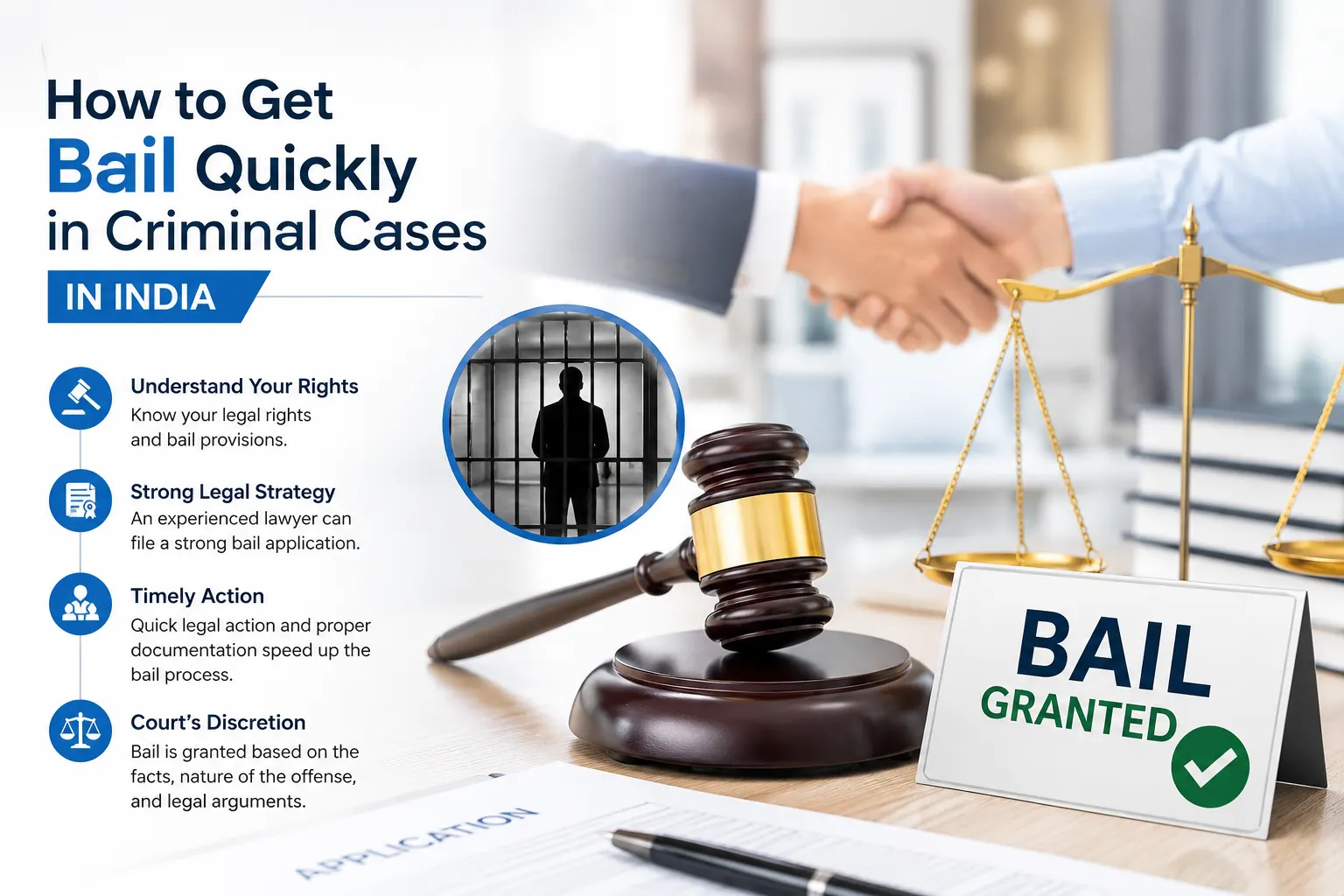
In life, sometimes a criminal case turns critical in a matter of minutes. One phone call from the police, one FIR, one notice from the police station or one arrest can disrupt an entire family. Family members often ask one question first, and it is direct: how to get bail quickly in criminal cases? Stay calm. There is no magic. There are practical steps. Under Indian criminal law, bail is not a favour. It is a legal process by which an accused person can be released from custody on conditions, so investigation or trial can proceed without unnecessary detention. Bail provisions are now mainly located in Chapter XXXV (478 to 496) of the Bharatiya Nagarik Suraksha Sanhita, 2023. In most families in Delhi NCR, Noida, Ghaziabad, Gurugram, Faridabad, Lucknow, Mumbai, Bengaluru, Hyderabad, Chennai, Kolkata or other cities, time becomes the enemy. Documents are not prepared. FIR is not reviewed. The accused makes statements out of emotion. Friends or family members rush to the police station without legal preparation. Panic sets in. That is when quick bail planning becomes essential. Advocate BK Singh guides clients through urgent bail situations, anticipatory bail, regular bail, police station meetings, court filings and documents, and early criminal defence strategy through Legals365. For more information on criminal defence or bail-related matters, read our verified Legals365 service page for criminal law in Delhi here: Criminal Lawyers in Delhi. Get familiar with bail. Read this article completely. Know your rights, time limits and options before reacting. But if police contact has already started, contact Advocate BK Singh or Legals365 immediately because early advice can make a huge difference. Bail matters in 2026 because criminal laws have changed. India now has the Bharatiya Nyaya Sanhita, 2023, Bharatiya Nagarik Suraksha Sanhita, 2023 and Bharatiya Sakshya Adhiniyam, 2023. You may read the full Bharatiya Nagarik Suraksha Sanhita, 2023 here. The Bharatiya Nagarik Suraksha Sanhita (BNSS) came into force on 1 July 2024 and consolidated the law relating to criminal procedure. Police, investigations, courts and citizens need quicker planning because of the new framework. Stages of arrest, remand, custody, investigation, bail requests and court appearances require faster legal understanding in 2026. A person accused in a criminal case can be arrested for bailable offences as well as non-bailable offences. Sections used will determine whether the offence is bailable or not. Bail conditions and options may differ. If the accused lives or works in Delhi NCR, the panic may also rise because cases can involve local Delhi Police stations, Judicial Magistrate Courts, Sessions Courts, Delhi High Court, surrounding courts in districts like Ghaziabad, Gautam Budh Nagar, Faridabad or Gurugram, and sometimes special or stricter laws like NDPS Act, POCSO Act, SC/ST Act, PMLA or UAPA. Advocate BK Singh has learned one basic truth: most families wait too long. They do not realize bail strategy is needed until after arrest happens. By then, options may be limited. Bail in bailable offences is usually available as a right under Section 478 BNSS. Conditions will apply. Regular bail decisions in non-bailable offences are discretionary. Courts will look at facts, seriousness, evidence, need for custody and other reasons. Anticipatory bail can be sought before Sessions Court or High Court if a person knows about a possibility of arrest in a non-bailable offence. File under Section 482 BNSS. Quick bail is usually based on first impressions at the police station or first court hearing. Preparation of FIR analysis, correct court, documents and surety advice is essential. Remember: bail is not acquittal or freedom from the case. The accused will need to defend the criminal case unless investigators close, discharge, drop, quash or convict the person. Delaying a bail request can harm the accused if the reason is serious. Repeat offences, threat to witnesses, absconding, recovery/status pending, non-cooperation are some examples. Adv BK Singh advises clients to never speak fast or make hurried police station statements without speaking to counsel. Questions like “how quickly can we get bail?” are valid. Clients are nervous. They just want answers. The better question may be: which bail remedy is right for the current stage of the case? If the offence is bailable, then the accused can ask for bail from the police or court. If the offence is non-bailable and the person knows about the possibility of arrest, then they can apply for anticipatory bail. If the person is already arrested and produced before court, then they can ask for regular bail. Any quick bail plan needs these three things: know whether offence is bailable or not as soon as possible; know which court has power to grant bail; gather documents and prepare surety advice before filing. Advocate BK Singh first reviews the FIR or notice, the exact sections mentioned, whether arrest has already happened, what custody status the accused is in, documents to prove identity/address/background, background of complainant or police Officer, if there were any previous disputes between parties, and any specific risk factors. Only then will he advise the family whether to apply for anticipatory bail, regular bail, interim protection from arrest or some other criminal law remedy. For most purposes, the law governing bail in India is now the Bharatiya Nagarik Suraksha Sanhita, 2023. The main Sections related to bail include the following Sections: When the offence is marked as bailable on the FIR or notice, bail is usually a matter of right. Once the accused or surety gathers the documents required by law for bail or bond, the police officer or court should not treat the offence like a severe non-bailable case. Remember: paperwork and surety details are still important. Just because an offence is non-bailable does not mean “no bail”. Non-bailable means that bail is not automatic. The court will look into the nature of the offence, role of the accused, evidence against the accused, whether police need custody for investigation, criminal background of the accused, likelihood of the accused fleeing from justice or influencing witnesses if released on bail. Anticipatory bail allows a person who “has reason to believe” that they may get arrested for a non-bailable offence to apply to the High Court or Court of Session for relief. Conditions can be added, like cooperate with investigation, not threaten witnesses, not leave India without court permission, and follow future orders from the court. Regular bail is the usual bail application that is done after a person is arrested. Once arrested and presented before court, regular bail can be sought. The court will hear the prosecution and look at the record of the case. If the offence is serious, the prosecution may oppose bail on grounds like ongoing investigation needs, gravity of offence, recovery is pending, witnesses need protection, likelihood of absconding or public interest. Default bail is a technical bail after the police investigation has crossed the statutory time limit. Each offence has its own time limit. See this blog on police investigation time limits. Default bail must be checked very carefully. Advocate Singh has seen innocent clients lose this right because their lawyers missed the timing by a few hours or did not know about this technical relief. Advocate BK Singh analyses these options before filing anything. Courts do not like bail applications wasting their time with futile or duplicate requests. Anyone who is named in an FIR, family member of an arrested person, contact who received a police notice or wrongdoing complaint against them, business owner who has received a criminal complaint against their company or commercial establishment, students accused in campus violence or online matters, life or professional accused of cheating, breach of trust, scam or fraud offences. If someone contacts police voluntarily to clear their name, those people should talk to a lawyer immediately before making any statements. Many criminal cases start from common disputes: money not returned, business deal went bad, family fight, neighbour fight, social media claim, office fight over salary or promotion, disagreement over property sale/purchase or rent, marriage breaks down. Then someone files a criminal complaint against the other side. Strong criminal sections are added to the FIR or police notice. Panic starts from this stage. Many readers in Delhi, New Delhi, Ghaziabad, Noida, Greater Noida City, Gurugram, Faridabad, Meerut, Hapur, Lucknow, Jaipur, Chandigarh, Bangalore, Mumbai, Pune, Hyderabad, Chennai, Kolkata, Ahmedabad or other parts of India tell us they searched online for “quick bail lawyer near me”, “urgent bail lawyer near me”, “anticipatory bail lawyer near me” or “best criminal lawyer near me” because the matter cannot wait. Advocate BK Singh empowers clients about quick bail options, anticipatory bail, police station strategy, regular bail applications, high court bail petitions if needed, and guiding clients about how to defend their criminal case. Get bail quickly by getting a copy of the FIR or police notice, understanding the exact sections mentioned, checking if offence is bailable or not as per law, gathering required identity documents and surety papers, avoiding informal statements, and filing the right bail application before the right court or forum. That is short answer. Now for the details. Do not believe only what a police officer, complainant or relative says over the phone. Police bail planning is dependent on the FIR. Is this cheating? Assault? Cyber case? Recovery? NDPS case? Matrimonial or marriage law issue? Simple character offense? Money fraud? Whatever the accusation, know the sections exactly. Treating a cheating case like a character offence will waste time and cost more. Clients who call ahead of arrest have more options. If police have not arrested the accused, they can potentially file for anticipatory bail. If police already arrested the person and presented them before a judge, regular bail is typically the immediate solution. If the offence is marked bailable on the FIR, the accused can seek bail from the investigating officer (station bail) or the Court (court bail), depending on where they are at. You need to know whether Bombay High Court, Delhi High Court or Supreme Court of India can decide your matter. Not all courts can hear all crimes. Not all courts can grant bail. File in the wrong court and your proper application will get rejected. Delay occurs. For anticipatory bail purposes, one can approach the High Court or Court of Session under Section 482 BNSS. Courts do not give bail just because your cousin or sister is crying at the police station. Drafting the bail application is about showing legal reasons.ments. These may include false allegations by complainant, willingness to cooperate with police/CBI investigation, no past criminal history to indicate fleeing from justice, roots in society to show they will not leave India, valid documents to prove identity/address/occupation are available, no need to question in custody because police have all evidence/recovered items, urgent medical condition, civil nature of dispute, delay in filing the FIR by the complainant (older cases), or other facts. Courts can delay granting bail if surety documents are incomplete or surety is not prepared. Decide on who will be surety. Gather proof of identity/address for accused + surety. Take recent photographs. Get documents to prove residence, rental agreement, property ownership or income where necessary. Once you know which court will take your bail application, check their rules for surety format. Have these documents ready. Once bail is granted, comply with all conditions. Do not contact the complainant, threaten witnesses, travel abroad if restricted from courts, avoid police investigations, or discuss the case on social media. Always remember: bail is a privilege, not right. Advocate BK Singh tells clients bail means police/CBI investigations are not over. Be prepared to defend the case. Photos that prove claims in bail applications help. Loose documents can cost your loved ones valuable time. In cybercrime, business cheating disputes, bank/payment frauds, cheque matters, employer employee complaints, or matrimonial disputes/outstation money complaints, preserve digital evidence. Do not delete chats. Do not edit screenshots. Save the device itself if possible. Bail is not the same 24 hours for every case. Simple matters in bailable offences may get solved the same day at the police station or during the first court appearance. Some anticipatory bail applications are heard immediately. Courts can issue notice to the prosecutor in serious offences. This delays matters. Some serious offences take longer because courts want to see investigation completed or case diary. Be especially careful in the first 24 to 72 hours from when an FIR is filed or arrest may happen. Use this time wisely to gather documents, contact lawyer, decide which court has jurisdiction to file bail, prep surety and avoid confrontation with the complainant. Remember: if the accused lies to police, refuses to sign notices or disappears, the investigating officer can say he is non-cooperative. If you threaten the complainant or shared this on social media, the complaint can get amended. If you create documents only after bail is granted, you surety “refuses to sign” your papers in court, your credibility suffers. Precious time should not be wasted. Advocate BK Singh recommends consulting a lawyer as soon as police start questioning families or relatives, especially in non-bailable offence cases. Lots of mistakes happen in Delhi NCR, Mumbai, Pune, Bangalore because families are panicked. Some fear is normal. Reaction based on fear leads to mistakes. Don’t panic. Prepare. Crime does not wait for you to settle your differences with the police or the person who made the complaint. Here are a few legal problems that get worse when ignored: A criminal case can disrupt education for students. Schools can suspend. Future educational applications and overseas opportunities can be denied. Business owners can see contracts terminated. Banking relationships suffer. Clients lose trust. Professionals can face enquiries from employers and future employers for background checks. Families can face stressful pressure no one should have to endure. An ongoing criminal case also stops you from speaking in public. A wrong phone call to the opposition, wrong text to the complainant, wrong social media update about the case or wrong promise given to police to “close” the case can harm your defence. Advocate Singh guides families through these difficulties with discipline. You should consult a criminal lawyer immediately if: Likewise, if the offence mentioned is against women, children (sexual assault or POCSO offences), relates to cyber law, NDPS section, accusations of serious assault, cheating, criminal breach of trust, forgery, extortion, company offenses, matrimonial cruelty or threats – please consult a lawyer immediately. In many cases, clients appreciate knowing about the matter before police arrive at their house. Some are happy they did not have to spend a night in police custody. Others are relieved they spoke to a lawyer first and avoided making false promises to police. Legals365 offers criminal law services for assistance with bail, FIR consulting, anticipatory bail applications, regular bail applications, police station support, court appearances, and criminal defence strategy. Visit our main Legals365 website to learn more about how we support clients with urgent legal problems and can connect you to immediate legal support. Advocate BK Singh will review the FIR, brief you on the legal risk, identify the quickest legal route, prepare a bail application if required, arrange documents and surety advice, and protect your family member’s liberty without panic or wrong mistakes. Visit our service page on NDPS Lawyers in Delhi if you need urgent bail support for drug offences in Delhi. By getting the FIR or notice, identifying what sections were mentioned, checking if the offence is marked bailable or non-bailable as per law, gathering necessary documents, and filing the correct bail application form before the correct court. Engage a lawyer first. Advocate Singh can assess your situation. No, bail is not guaranteed in India for every criminal offence. If the offence is bailable as per the First column of Schedule I to BNSS, then yes, bail can be a right. Non-bailable offences are evaluated by the courts on facts of the case, seriousness, evidence, gravity and reasons to keep accused in police custody. Anticipatory bail is when a person has “reason to believe” they may get arrested for a non-bailable offence. In India, such persons can apply for anticipatory bail from the Sessions Court or High Court under Section 482 BNSS. Regular bail is a bail application filled after arrest happens. The accused seeks relief from court that they do not have to remain in police custody while investigation/trial continues. In most bailable offences, yes. Police can allow the accused to go home on bail or bond as per law. In non-bailable offences, usually the court will have to hear the accused and grant bail. Every case is different. Matters are resolved quickly if the offence is bailable or both parties agree. Some serious offences take longer because the court may ask the prosecutor to file a status report or share the case diary. Yes. If the court feels the allegations are serious, or if accused may flee from justice, influence witnesses or interfere with the investigation, the judge can deny bail to the accused. Copy of FIR, arrest memo/remand, identity proof, address proof, any medical documents if claiming urgency on medical grounds, proof of employment/business where necessary, any previous complaints or history of dispute you know about (may help identify motive), relevant document proving your claims. Messages on WhatsApp/email/docs can also be very useful in financial/commercial disputes, cheque cases or relationship disputes. Yes. Advocate BK Singh helps clients get urgent review of bail conditions, applies for anticipatory bail, works on regular bail applications, meets police stations with clients, and advises on how to defend their criminal case. No. If police grant bail or courts grant bail, it does not mean the case goes away. Remember police investigation or trial will continue until police close the case, court discharges the accused, complaints are dropped, matters are quashed by High Court or finally convicted by trial court/Judicial Magistrate. Bail quickly does not mean rushing to file bail applications. If police have arrested your husband, wife, father, mother, brother or sister; if police have told you they will arrest your loved one; if you received a legal notice today or fear you will be arrested for a non-bailable offence, take deep breaths and act quickly. Review the FIR or notice. Start gathering documents. Avoid making statements. Know the correct bail remedy to seek. Advocate Singh and Legals365 can guide your family through this process. Articles published by Legals365 consist of general information only and should not be used as a substitute for professional advice concerning your specific issue. For your own protection, never disclose your personal information in a public comment and never accept advice without consulting a qualified attorney first.Quick Bail Process in Criminal Cases in India: Your Questions Answered
Why This Issue Matters in India, Delhi NCR and Major Cities in 2026
Quick Facts
Understanding the Core Legal Issue
What Is the Legal Framework for Bail in Criminal Cases?
Bailable Offence
Non-Bailable Offence
Anticipatory Bail
Regular Bail
Default Bail
Who Needs This Guidance?
How to Get Bail Quickly in Criminal Cases?
Step 1: Get the FIR, Notice or Basic Details About the Case
Step 2: Check Arrest Status
Step 3: Understand Which Court to Approach
Step 4: Prepare Your Bail Story and Documentation
Step 5: Have Surety and Documents Ready Before Asking for Bail
Step 6: Follow Bail Conditions Religiously After Arrest
Documents and Evidence Checklist
Documents
Reason Why It Helps
FIR copy/police notice
Exact sections and allegations come from here
Arrest memo/remand paper
Helps identify if arrest has occurred
Identity proof
For bail/bond application and surety
Address proof
Roots in society/location details
Medical documents
Urge medical ground bail
Employment/business proof
Shows employment stability
Previous dispute/complaint background
Useful in identifying repeat offences or motivations
Whatsapp/email/payment evidence
Useful in financial/disputed cases, cheques complaints
Civil settlement messages
Helpful if compromise/civil settlement was discussed
Timelines, Practical Delays and Decision Windows
Common Mistakes People Make
Risks of Ignoring the Matter
When Should You Consult a Lawyer for Bail?
How Legals365 Can Help
Frequently Asked Questions
1. How can I get quick bail in a criminal case?
2. Is bail guaranteed in India?
3. What is anticipatory bail?
4. What is regular bail?
5. Can police grant bail?
6. How long does it take to get bail?
7. Can bail be rejected?
8. What documents are needed for bail?
9. Can Advocate BK Singh help if I need urgent bail?
10. Does bail mean the criminal case ends?
Final Thoughts
Disclaimer
Author Bio
There's no reason for concern. There is no difficult-to-understand legalese.
Someone who has helped many people with the same problems gives you clear, honest advice. We want to make the legal process easy to understand and use for everyone.
+91-9625961599 Chat on WhatsAppSchedule Your Consultation


